1. Introduction
What is digital eye strain?
Digital eye discomfort is a physical state caused by the forced, continuous focus of the eyes on screens for long periods. Compared to a printed book, where crisp characters remain set against an unchanging background, digital screens consist of tiny pixels that constantly dance and swirl. This makes the tiny muscles inside your eyes work so much harder to maintain a clear image. It is really just a repetitive strain injury for your visual system: it happens when the demand of the screen exceeds your eyes’ ability to keep a comfortable, clear focus without hitting total fatigue. Often, this is just one part of a larger sensory overload syndrome that modern technology can trigger.
What is another name for it?
In clinical settings and professional healthcare environments, this condition is formally referred to as Computer Vision Syndrome, or CVS. While the name sounds a bit intimidating, it is simply a catch-all term for how our eyes respond to high-energy visible light and the specific focal points required by modern digital devices. These modern screens require much different work from our eyes than traditional reading tasks, which is why CVS has become a dedicated field of study for eye doctors today. Many people don’t realize that the hidden blue light effects from these devices play a massive role in how this syndrome develops.
Is digital eye strain permanent?
One of the most common worries is whether spending eight hours a day in front of a monitor will leave long-term damage. Fortunately, digital eye strain is a functional issue and not a permanent structural change to your eyes. It does not cause the eyeball to lengthen or the cornea to scar. Rather than permanent vision loss, it manifests as temporary muscle fatigue and a gritty, dry surface on the eye. While the symptoms can feel like hell during a busy workday, they are not a permanent impairment; you are not “breaking” your eyes by using a laptop.
Can eye strain go back to normal?
The most encouraging aspect of this condition is that your eyes are remarkably resilient. Recovery is essentially a matter of muscular “reset.” Because the discomfort is caused by the ciliary muscles being locked in a near-focus position, simply shifting your gaze to the horizon allows these systems to unclench. By implementing better habits, such as the 20-20-20 rule or adjusting your lighting, you can reverse the immediate effects of the strain. Your eyes return to their healthy, comfortable state because you are finally allowing the biological “recharge” that happens when the blink rate returns to a normal frequency.
2. Causes & Risk Factors
Does eye strain cause bad eyesight?
There is a common fear that staring at screens will eventually lead to a permanent need for stronger glasses, but the truth is a bit more nuanced. While digital eye strain causes significant discomfort and temporary blurring, it does not actually cause “bad eyesight” in terms of permanent structural damage or a change in your eye’s shape. It is a form of muscle fatigue rather than a decline in vision health. However, if you already have a slight, undiagnosed vision issue, the strain of screen work will magnify that problem, making it feel as though your eyesight is getting worse when your eyes are simply exhausted from overcompensating. Building overall hormesis and resilience can help your body handle these minor physical stressors more effectively.
Can lack of sleep cause eye strain?
Your eyes rely on sleep just as much as your brain does for restoration. When you don’t get enough rest, the muscles that control your eye movements and focal point don’t have the opportunity to fully recover from the previous day’s work. Furthermore, a lack of sleep can lead to a decrease in tear production, which is a major biological factor in eye comfort. Without that protective layer of moisture, your eyes become dry and irritated much faster when looking at a screen. Essentially, being tired lowers your “threshold” for discomfort, meaning you will feel the effects of eye strain much sooner than you would after a full night of rest. Just as you might ask is your brain dehydrated when you feel foggy, your eyes also suffer from a lack of internal hydration and rest.
Can stress worsen digital eye strain?
Stress is not just a mental state; it has a profound physical impact on how your body functions, including your vision. When you are under pressure, you often unknowingly clench your jaw and tighten the muscles around your neck and temples. This tension can radiate to the small muscles surrounding the eyes, making them feel tight and sore. Additionally, stress can cause a “fight or flight” response that slightly dilates your pupils, making you more sensitive to light and glare. This psychological-physical link means that a high-stress workday often feels physically much harder on your eyes than a relaxed one, even if the screen time is identical.
Is dark mode better for my eyes?
The debate over dark mode is popular, but the answer depends entirely on your environment. Dark mode can be better for your eyes when you are in a dimly lit room because it reduces the overall amount of bright light hitting your retinas, which helps prevent that “flashlight in a dark room” sensation. However, in a well-lit office, high-contrast black text on a white background is actually easier for many people to read because it triggers a smaller pupil size, which creates a sharper image. If you find yourself squinting or if the white text seems to “bleed” into the black background, dark mode might actually be adding to your strain rather than fixing it.
Why do I blink less when looking at a screen?
It sounds strange that we would “forget” a basic biological reflex, but it is a documented phenomenon. When we look at a digital screen, our concentration becomes so intense that our blink rate drops by about 60% to 70%. Normally, you might blink 15 times a minute, but on a laptop, that can drop to just 5 times. Because blinking is the way your body spreads a fresh layer of moisture over the eye, this lack of movement causes the tear film to evaporate. This leads to that gritty, burning sensation that is so characteristic of digital eye strain. You aren’t just tired; your eyes are literally drying out because they aren’t being lubricated often enough.
3. Symptoms
What are the first signs of eye strain?
Early detection is key to preventing a minor annoyance from turning into a full-blown headache. The first signs are often quite subtle, appearing as a slight heaviness in the eyelids or a frequent urge to blink to clear your vision. You might notice that you are squinting more often to read small text or that your eyes feel unusually dry and “gritty” by mid-morning. Another early indicator is a subtle decrease in focus speed; if you look away from your screen to a far wall and it takes a second or two for the image to sharpen, your focusing muscles are already starting to signal fatigue.
What does it feel like and how painful is it?
The physical sensation of digital eye strain is rarely a sharp or stabbing pain, but rather a deep, persistent ache that feels like it sits right behind the eyeballs. Many people describe it as a “burning” or “stinging” sensation, often accompanied by the feeling that there is a foreign object, like a grain of sand, stuck under the lid. While the pain level is generally moderate, its persistence is what makes it taxing. It can escalate into a dull throb in the temples or a frontal headache, making it difficult to maintain concentration for the remainder of your tasks.
How many days does digital eye strain last?
Fortunately, the duration of these symptoms is typically short-lived compared to other physical injuries. In most cases, the discomfort lasts only as long as the eyes are being pushed past their limit. Once you step away from the digital device and get a restorative night of sleep, the symptoms usually resolve within 12 to 24 hours. However, if you are in a cycle of chronic overwork without proper breaks, the symptoms can linger for several days, creating a lingering “hangover” effect where your eyes feel sensitive and easily fatigued the moment you sit back down to work. Just as you might look for scientific benefits of ice baths to recover after a workout, your eyes require their own specific forms of down-time to reset.
Why does eye strain cause neck and shoulder pain?
The human body is highly interconnected, and when your vision is struggling, your posture follows suit. When your eyes cannot clearly parse the information on a screen due to glare or poor contrast, you instinctively lean forward and crane your neck to see better. This “tech neck” position puts immense strain on the cervical spine and the trapezius muscles. Furthermore, the effort of trying to focus the eyes can cause sympathetic tension in the neck and shoulders. You aren’t just straining your eyes; you are locked in a rigid physical stance that turns a visual problem into a musculoskeletal ache. Practicing untapped home workout programs can help strengthen the muscles needed to maintain a better posture during long work sessions.
Can digital eye strain cause light sensitivity (photophobia)?
Yes, a very common but often overlooked symptom of screen fatigue is an increased sensitivity to light, technically known as photophobia. When your eyes are overworked and the protective tear film is thin, the surface of the eye becomes irritated and inflamed. This inflammation makes the nerve endings in the eye much more sensitive to bright overhead lights and even natural sunlight. If you find yourself wanting to dim the lights in your room or if the glare from a window feels suddenly aggressive, it is likely a sign that your eyes are in a heightened state of strain and need a dark environment to recover.
4. Diagnosis
What can be mistaken for eye strain?
It is very easy to blame your computer for every ocular discomfort, but several other conditions can masquerade as digital eye strain. For example, seasonal allergies often cause the same redness, itching, and watering that we associate with a long day of screen time. Similarly, a low-grade bacterial or viral infection, like pink eye, can cause a gritty sensation and light sensitivity. Even underlying conditions like chronic dry eye syndrome or certain types of ocular inflammation can mimic the fatigue of screen use. Ruling these out is essential because while a break from your phone will fix eye strain, it won’t cure an infection or an allergic reaction that requires specific medical intervention.
Do I need glasses?
Sometimes the “strain” you feel isn’t actually caused by the screen itself, but by a vision problem that your eyes are struggling to hide. If you have a slight, uncorrected prescription for farsightedness or astigmatism, your internal eye muscles have to work double-time to pull the digital image into focus. Over the course of several hours, this constant muscular effort leads to exhaustion. Many people find that getting a pair of dedicated “computer glasses” or light prescription lenses completely eliminates their symptoms. If you find that the blurriness persists even after you have rested, it is a strong signal that the problem isn’t just fatigue, but a need for corrective lenses to assist your natural focus. Much like building bridges to care in specialized clinics, getting an eye exam is the first step in identifying whether the issue is environmental or anatomical.
Will it fix itself?
The short answer is that while the symptoms of eye strain will temporarily fade with rest, the underlying problem will not fix itself if your habits and environment remain the same. Ignoring the signs—like persistent headaches or blurry vision—is a dangerous game because it leads to a cycle of chronic discomfort that can eventually impact your productivity and overall well-being. If you continue to push through the pain without adjusting your monitor height, lighting, or break schedule, you are essentially asking your eyes to perform a task they aren’t equipped to handle. While you won’t go blind from ignoring eye strain, you will likely suffer from recurring pain that becomes easier to trigger over time. To better understand how your body handles various physiological signals, you might explore the optimization of metabolic health to ensure your overall energy levels and recovery systems are functioning at their peak.
5. Treatment
How do you fix or reverse it?
Fixing digital eye strain requires a two-pronged approach: immediate relief and habitual adjustment. The first step in active recovery is to change your focal distance; look away from your screen at something far away to allow the ciliary muscles inside your eyes to physically unclench. You should also check your environment for “glare sources”—like an unshaded window or a bright overhead lamp—that force your eyes to work harder than necessary. Adjusting your screen brightness to match the room’s ambient light and increasing the font size on your devices are also immediate ways to reverse the physical tension. These small, mechanical changes reduce the “load” on your visual system instantly.
Can eye drops help and which ones are best?
Eye drops can be a highly effective medicinal tool for managing the dryness associated with screen use. Because we blink less when looking at pixels, our natural tears evaporate, leaving the eye surface exposed and irritated. When choosing a drop, it is best to look for “preservative-free artificial tears.” These are designed to mimic your natural tear film without the harsh chemicals found in “redness-relief” drops, which can actually cause rebound irritation if used too often. Using a lubricating drop a few times a day can provide a protective barrier that keeps your eyes comfortable even during intense periods of concentration. Sometimes, supplementing your diet with nutrients like magnesium glycinate can also support overall muscle relaxation and nerve function, which may indirectly assist with physical tension.
Does closing your eyes help?
Closing your eyes is the simplest and most direct recovery method available, acting as a “reset button” for your visual system. When you close your eyes, you are doing two vital things: you are completely eliminating the light stimulus that causes the retina to work, and you are allowing the tear film to redistribute evenly across the ocular surface. Even a “micro-nap” for the eyes—closing them for 60 seconds every hour—can provide enough of a break to prevent the build-up of severe tension. It provides a moment of total darkness and moisture that no other treatment can replicate, giving your internal focusing muscles the brief period of total relaxation they need to continue working. This period of rest is a vital part of maintaining health programs that prioritize long-term physical well-being.
6. Prevention
What is the 20-20-20 rule?
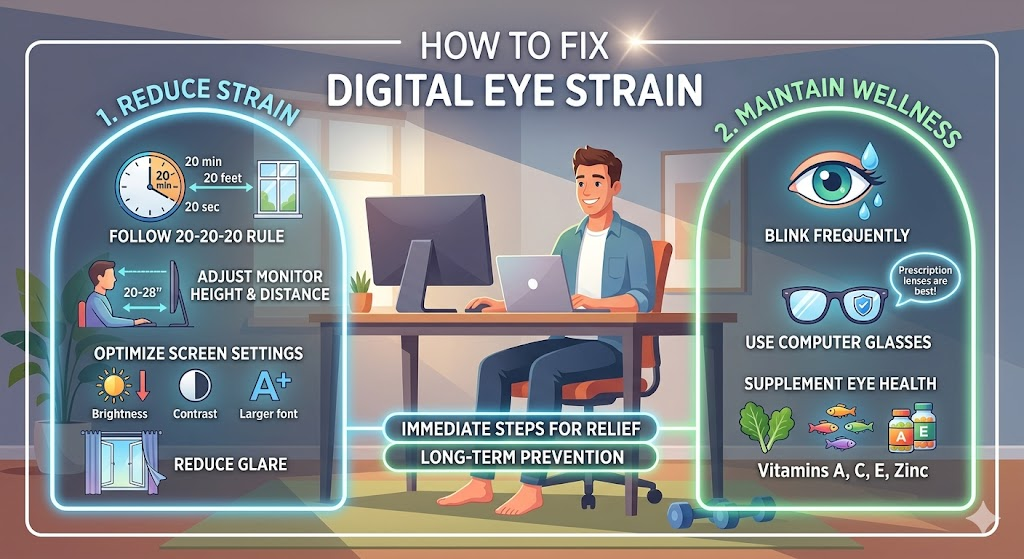
The 20-20-20 rule is widely considered the gold standard habit for maintaining eye health in a digital-first world. The concept is simple and designed to break the cycle of continuous near-focus strain: every 20 minutes, you should look at something at least 20 feet away for at least 20 seconds. This 20-second window is the physiological “sweet spot” that allows the ciliary muscles inside your eyes to fully relax from their contracted state. By looking into the distance, you are essentially stretching these muscles, preventing the stiffness and fatigue that lead to chronic headaches and blurred vision by the end of the workday.
What glasses are best?
When it comes to protecting your vision, not all eyewear is created equal. While “blue light blocking” glasses have become a popular trend, their effectiveness is often debated; they are primarily useful for late-night screen use to prevent blue light from disrupting your sleep cycle. For true relief from strain, prescription computer lenses are often a superior choice. Unlike standard reading glasses or everyday bifocals, computer lenses are specifically optimized for the “intermediate” distance of a monitor. They often feature an anti-reflective coating to eliminate glare and a slight tint to improve contrast, allowing your eyes to remain relaxed while parsing digital text for hours on end. For those interested in natural ways to support bodily systems, exploring the benefits of ashwagandha might offer insights into managing the systemic stress that often accompanies visual fatigue.
How far should my monitor be from my eyes?
The physical distance between you and your screen is a critical factor in how hard your eyes have to work. Ideally, your monitor should be positioned between 20 and 28 inches away from your face—roughly an arm’s length. If the screen is too close, your eyes must converge and focus more intensely, which rapidly increases muscle fatigue. Furthermore, the top of the monitor should be at or slightly below eye level. This positioning ensures that you are looking slightly downward, which allows your upper eyelids to cover more of the eye surface, reducing tear evaporation and keeping your eyes naturally moist throughout the day. Much like the science of barefoot health focuses on natural alignment, proper ergonomic alignment of your workstation is essential for long-term comfort.