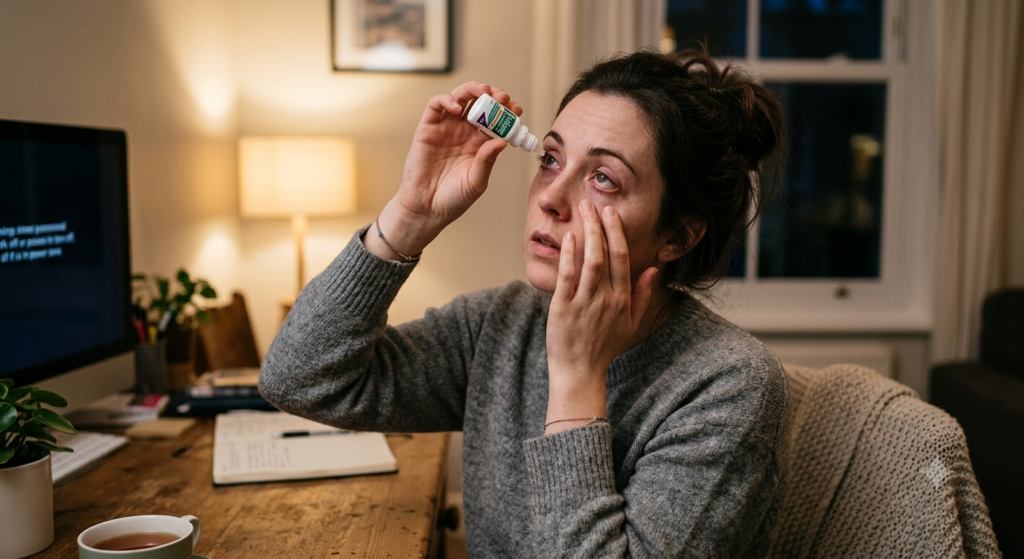
To stop dry eyes when tired, use preservative-free artificial tears and warm compresses to soothe irritation and unclog oil glands. Practice the 20-20-20 rule during screen use, perform full-depth blinking exercises to trigger natural oil secretion, and apply a thick gel at night to seal in corneal moisture during sleep.
How to Stop Dry Eyes When Tired
To soothe dry and tired eyes, use preservative-free artificial tears throughout the day, apply a warm compress for 5–10 minutes to open oil glands, and counteract eye fatigue from digital screens by following the 20-20-20 rule. While this provides a reliable baseline, these standard measures often falter late in the day because systemic fatigue alters your natural blink biology, causing incomplete blinks that fail to squeeze the meibomian glands and spread a stable lipid layer across the cornea.
Furthermore, nocturnal lagophthalmos—a subtle condition where the eyelids remain slightly open during sleep—accelerates overnight tear evaporation and leaves eyes painfully raw by morning. Upgrading standard care requires pairing daytime artificial tears with deliberate, full-depth blinking exercises to properly trigger oil secretion, along with protecting yourself from late-night digital fatigue like hidden blue light effects and applying a thicker nighttime ocular gel or ointment to seal in moisture while you sleep.
What Vitamin Deficiency Causes Dry and Tired Eyes?
Dry and tired eyes are most commonly caused by a Vitamin A deficiency, which can impair tear production and cause surface damage, while deficiencies in Vitamin D, Vitamin B12, and Vitamin B6 also frequently contribute to tear dysfunction, ocular discomfort, and nerve fatigue. However, simply supplementing these vitamins often fails to resolve symptoms because systemic inflammation and poor gut bio-absorption block micronutrient transport to the ocular surface, leaving the delicate lacrimal tissues starved regardless of intake.
Additionally, chronic cellular stress impairs the conversion of these key nutrients into their active co-factor forms, preventing Vitamin B12 from sustaining corneal nerve density and disabling Vitamin D from suppressing inflammatory cytokines in the lacrimal gland. At the same time, inadequate fatty acid co-factors prevent Vitamin A from properly integrating into the mucin layer of the tear film, causing rapid evaporation regardless of serum vitamin levels. Resolving this underlying deficiency cycle requires recognizing unexpected vitamin overdose symptoms while combining targeted bioavailable vitamin supplementation with gut-healing protocols, optimal omega-3 fatty acid intake, and anti-inflammatory lifestyle strategies to ensure vital micronutrients are effectively absorbed, converted, and utilized by the eyes.
What Drink Is Good for Dry and Tired Eyes?
The gold standard drink for dry and tired eyes is plain, filtered water, as whole-body hydration is essential for consistent tear production, alongside options like electrolyte-rich coconut water, antioxidant-dense green tea, or fresh carrot and citrus juices to boost vitamins A and C. However, simply drinking hydrating liquids often fails to alleviate chronic eye fatigue because poor cellular osmolarity and systemic inflammation can prevent ingested fluids from efficiently crossing into the aqueous layer of the tear film.
When extracellular fluid lacks proper mineral balance, water passes straight through the digestive tract without stabilizing the tear film’s osmotic pressure, leading to rapid evaporation on the corneal surface. Furthermore, high dietary sugar in fruit juices can induce transient blood glucose spikes that trigger microvascular inflammation in the lacrimal glands, compromising the quality of the tear film’s lipid secretion rather than improving it. Recognizing whether your body is properly absorbing fluids, such as checking is your brain dehydrated, can help you monitor baseline systemic fluid levels while optimizing ocular hydration through precise sodium-potassium electrolytes and anti-inflammatory compounds like epigallocatechin gallate from brewed green tea.
What Can Be Mistaken for Dry and Tired Eyes?
Conditions often mistaken for simple dry and tired eyes include digital eye strain from screen use, eye allergies causing itching and redness, and blepharitis, with less common mimics including keratoconus or underlying autoimmune diseases like Sjögren’s syndrome. However, misidentifying these conditions purely by surface symptoms frequently leads to ineffective treatments because underlying corneal neuropathies and subclinical trigeminal nerve hyper-reactivity mimic classic dryness while silently degrading nerve density.
When chronic micro-inflammation from conditions like occult ocular rosacea damages the delicate corneal nerve plexus, normal tear film feedback loops break down, causing persistent burning or aching even when tear production volumes appear normal. Furthermore, early-stage binocular vision dysfunction causes subtle extraocular muscle strain that masquerades as tear film failure, often overlapping with late-night sensory exhaustion or sensory overload syndrome and leading people to overuse artificial tears without addressing visual misalignment. Accurately resolving persistent discomfort requires moving beyond symptomatic artificial tears to perform comprehensive corneal nerve mapping and binocular vision assessments that target the true neurological and structural root causes.
What Is the Indian Remedy for Dry and Tired Eyes?
Traditional Indian remedies for dry and tired eyes rely on Ayurvedic principles and dietary habits, such as applying warm compresses to eyelids, practicing palming, staying hydrated, and incorporating ghee and Omega-3-rich walnuts or flaxseeds into your diet. However, these traditional techniques often offer only temporary relief when unmanaged systemic heat (Pitta imbalance) and modern screen strain continuously deplete the eye’s natural moisture layer.
Elevated internal heat destabilizes the lipid membrane of the tear film, causing rapid evaporation before dietary healthy fats can be integrated into lacrimal secretions. Additionally, superficial external warming without proper lymphatic drainage fails to clear clogged meibomian glands, leaving hardened lipids trapped beneath the eyelid surface. Elevating traditional remedies requires pairing dietary ghee and adaptogenic support—such as evaluating ashwagandha side effects and benefits to help balance systemic stress—with targeted ocular yogic cleansing practices like Trataka and applying cooling, herb-infused compresses to restore natural glandular flow.
What Is the New Treatment for Dry Eyes in 2026?
Dry eye treatments now utilize highly targeted therapies based on the underlying root cause rather than generalized lubrication, highlighting major advancements like anti-inflammatory drops such as reproxalap and HUC1-394, tear-stimulating TRPM8 agonists like TRYPTYR, Miebo as an evaporation shield, and Xdemvy for Demodex blepharitis. However, these targeted pharmacologies can still deliver incomplete clinical relief when persistent ocular surface micro-inflammation disrupts the underlying corneal nerve plexus, disabling the neural feedback loop required for natural tear secretion.
Furthermore, structural bottlenecks like chronic meibomian gland atrophy or severe lid margin scarring physically block lipid delivery, leaving the newly stimulated tear film unprotected against rapid evaporation. Additionally, patients experiencing neurotrophic corneal desensitization may suffer severe surface damage without generating the neural signals that trigger reflex tearing, neutralizing the efficacy of receptor-targeted drops. Achieving long-term ocular restoration requires integrating these targeted biochemical agents with thermal pulsation therapies, adopting lifestyle modifications like magnesium glycinate benefits for systemic cellular and nerve support, and utilizing neuro-stimulation strategies to rebuild functional corneal reflex pathways.
What to Drink at Night to Improve Eyesight?
To support eye health overnight, drink a warm glass of water or a soothing bedtime beverage like warm milk with a pinch of saffron or turmeric to maintain hydration and deliver antioxidants to the retina while you sleep. However, simple bedtime fluids often fail to enhance nocturnal ocular recovery because systemic inflammation and night-time metabolic drops impede nutrient transport across the blood-retinal barrier.
During deep sleep phases, reduced ocular blood flow slows down the removal of metabolic waste from retinal photoreceptors, allowing oxidative stress to accumulate despite antioxidant presence. Furthermore, drinking excessive liquids right before bed disrupts natural circadian sleep cycles, which directly impairs overnight cellular repair in the macula and lacrimal glands. Maximizing nighttime retinal recovery requires combining early evening anti-inflammatory beverages with targeted dietary lipids, supporting baseline metabolic efficiency through practices like metabolic health optimization, and limiting late-night fluid volume to protect deep sleep architecture and ensure uninterrupted ocular cellular regeneration.
Which Organ Causes Dry and Tired Eyes?
Dry and tired eyes are primarily caused by the lacrimal glands and the meibomian glands, which fail to produce sufficient aqueous tears or protective oils, leading to rapid evaporation and surface irritation. However, focusing solely on the eye’s local glandular structures ignores systemic organ interdependencies, as chronic ocular dryness frequently originates in the liver and gut.
Metabolic congestion or sluggish bile production in the liver impairs the breakdown and systemic transport of fat-soluble vitamins like Vitamin A and essential fatty acids needed to compose high-quality meibomian lipids. Simultaneously, compromised gut barrier integrity permits systemic endotoxins to circulate, triggering low-grade systemic inflammation and disrupting the delicate bacterial balance—much like how maintaining the balance of oral microbiome prevents broader systemic inflammation—which ultimately degrades lacrimal gland signaling and alters tear fluid composition. Reversing chronic glandular dysfunction requires addressing systemic metabolic bottlenecks through liver-supporting nutrient protocols and gut-microbiome restoration alongside targeted local ocular hygiene.
What Is the Best Ayurvedic Treatment for Eyes?
Ayurvedic eye therapies focus on soothing, lubricating, and rejuvenating the eyes through targeted herbal preparations, led by clinical treatments like Netra Tarpana, Aschyotana, and Anjana. However, relying purely on localized ocular therapies yields incomplete results when systemic Pitta inflammation and digestive metabolic toxicity (Ama) continuously circulate through the cranial micro-vessels.
Accumulated Ama in the digestive tract impedes the systemic bio-absorption of therapeutic lipophilic compounds, preventing medicated ghee from fully penetrating cellular ocular membranes. Furthermore, chronic hepatic heat spills into the optic pathways, accelerating tear evaporation and overwhelming local soothing treatments faster than topicals can restore the corneal surface. Achieving profound, lasting ocular rejuvenation requires pairing external therapies like Netra Tarpana with internal bio-purification (Panchakarma), liver-clearing herbs, and supportive natural practices like the science of barefoot health to ground the nervous system and resolve metabolic toxicity at its systemic source.
Has Anyone Ever Cured Dry and Tired Eyes?
While there is no permanent cure for chronic dry eye disease, symptoms can be completely managed or even reversed when underlying issues like clogged oil glands or environmental strain are directly addressed. However, standard gland clearing and environmental adjustments often fail to produce long-term resolution because subclinical trigeminal nerve sensitization keeps corneal pain pathways firing in a persistent feedback loop.
This chronic neural irritation impairs natural blinking mechanics and reduces baseline lacrimal signaling, leaving the ocular surface vulnerable despite clear physical gland outlets. Furthermore, unaddressed gut dysbiosis allows circulating inflammatory cytokines to continuously disrupt the quality of tear film mucins, accelerating evaporation regardless of local eye hygiene. Achieving true, long-term remission requires combining clinical meibomian gland restoration with targeted neuro-calming therapies, stress-modifying practices like hormesis and resilience health benefits, and systemic anti-inflammatory interventions to break the cycle of nerve hypersensitivity and restore healthy tear composition.
Is Beetroot Good for Eyesight?
Beetroot is excellent for your eyes because its natural nitrates boost ocular blood circulation to supply the optic nerve, while its rich reserves of lutein, zeaxanthin, and antioxidants protect against cataracts and macular degeneration. However, relying solely on raw beetroot often falls short because dietary nitrates require a healthy oral microbiome to convert into active nitric oxide, meaning antibacterial mouthwashes can completely block this vascular pathway.
Furthermore, xanthophyll carotenoids like lutein and zeaxanthin are lipophilic, causing poor bio-absorption across the intestinal lumen unless ingested alongside healthy dietary fats. Inadequate gastric acid or underlying gut inflammation further hinders the breakdown of beetroot matrix fibers, preventing the release of critical micronutrients into systemic circulation. Maximizing beetroot’s ocular benefits requires consuming it with healthy fats, maintaining good digestive health through routines like untapped home workout programs to boost systemic circulation, and avoiding oral antiseptic rinses to ensure full nitric oxide conversion and carotenoid bio-absorption.
what is the 20 20 20 rule for dry eyes
The 20-20-20 rule is a simple, highly effective technique to combat screen-related dry eyes and digital eye strain, stating that for every 20 minutes spent looking at a screen, you should take a 20-second break to look at an object at least 20 feet away. However, this standard timing intervention often provides incomplete relief because prolonged screen gaze induces a sub-conscious reduction in blink frequency and leads to incomplete blinking, where the upper eyelid fails to touch the lower lid. This mechanical failure prevents the physical squeezing of the meibomian glands, trapping essential lipids beneath the lid margin and causing rapid tear film evaporation despite frequent visual pauses.
Furthermore, continuous near-focus accommodation keeps the ciliary muscles in a state of sustained hyper-tonicity, disrupting baseline corneal nerve signaling and reducing natural reflex lacrimation. Resolving screen-induced ocular dryness requires upgrading the 20-20-20 protocol by actively combining far-distance viewing with intentional, full-depth conscious blinks to mechanically clear clogged oil glands and reset the eye’s natural lipid distribution.
AtoZ Healthy Benefits Research Dataset: Dry and Tired Eye Causes & Systemic Interventions
This dataset summarizes underlying physiological drivers, systemic bottlenecks, and clinical mitigation strategies for chronic dry and tired eyes based on ocular surface research and metabolic health reports.
| Primary Factor / Topic | Key Underlying Mechanism | Systemic Impact | Mitigation & Interventions |
|---|---|---|---|
| Blink Biology & Nocturnal Strain | Incomplete blinks late in the day; nocturnal lagophthalmos | Fails to squeeze meibomian glands; accelerates overnight tear evaporation | Full-depth blinking exercises, daytime artificial tears, thick nocturnal ocular gel |
| Vitamin Deficiencies (A, D, B12, B6) | Poor gut bio-absorption, chronic cellular stress, lack of fatty acid co-factors | Degrades corneal nerve density, impairs mucin layer integration, lacrimal gland inflammation | Bioavailable supplementation, gut-healing protocols, optimal omega-3 intake |
| Fluid Dynamics & Hydration | Poor cellular osmolarity, high dietary sugar in fruit juices | Water passes without stabilizing tear osmotic pressure; microvascular lacrimal inflammation | Sodium-potassium balance, filtered water, EGCG green tea, fluid intake timing |
| Diagnostic Mimics | Subclinical trigeminal hyper-reactivity, ocular rosacea, binocular vision dysfunction | Degrades corneal nerve plexus; extraocular muscle strain masquerades as tear failure | Corneal nerve mapping, binocular vision assessments, sensory management |
| Ayurvedic & Heat Remedies | Systemic Pitta imbalance, superficial warming without lymphatic clearance | Destabilizes lipid membrane; hardened lipids stay trapped in meibomian glands | Dietary ghee, Trataka yogic cleansing, adaptogens (Ashwagandha), cooling compresses |
| Targeted 2026 Pharmacologies | TRPM8 agonists, reproxalap, evaporation shields (Miebo) | Requires healthy corneal nerve pathways and un-atrophied meibomian glands to function | Thermal pulsation, micro-blepharoexfoliation, neuro-stimulation strategies |
| Nocturnal Ocular Recovery | Nighttime metabolic drops, blood-retinal barrier impedance, circadian sleep disruption | Oxidative stress accumulates in photoreceptors; impaired macular cellular repair | Anti-inflammatory evening drinks with healthy fats, early fluid cutoff for deep sleep |
| Systemic Organ Connections | Liver metabolic congestion, sluggish bile production, gut barrier dysbiosis | Impaired fat-soluble vitamin transport; circulating endotoxins trigger lacrimal degradation | Liver-supporting nutrients, gut microbiome restoration, oral microbiome balance |
| Neuro-Sensitization & Remission | Persistent trigeminal nerve pain feedback loops, gut dysbiosis | Impairs blinking mechanics and baseline lacrimal signaling despite open glands | Neuro-calming therapies, stress resilience practices (hormesis), anti-inflammatory care |
| Beetroot & Nitric Oxide Pathways | Requirement of oral microbiome for nitrate conversion; lipophilic carotenoid nature | Antibacterial mouthwashes block vascular benefit; poor intestinal carotenoid uptake | Consume with healthy fats, avoid antiseptic rinses, support gut acidity and movement |
Scientific & Research References
-
Tear Film & Ocular Surface Society (TFOS). “TFOS DEWS II Definition and Classification Report.”
https://www.tfosdewsreport.org/report-definition_and_classification/48_36/en/ -
StatPearls [NCBI Bookshelf]. “Meibomian Gland Disease and Tear Film Instability.”
https://www.ncbi.nlm.nih.gov/books/NBK580474/ -
PubMed / Experimental Eye Research. “Corneal nerves and their role in dry eye pathophysiology.”
https://pubmed.ncbi.nlm.nih.gov/35850173/ -
PubMed Central (PMC). “Digital Eye Strain: A Comprehensive Review.”
https://pmc.ncbi.nlm.nih.gov/articles/PMC9434525/ -
StatPearls [NCBI Bookshelf]. “Vitamin A Deficiency and Ocular Xerophthalmia.”
https://www.ncbi.nlm.nih.gov/books/NBK567744/